Prompt Injection Attack Surfaces in Production Agents
Autonomous agents reading untrusted content face a production-scale prompt injection problem.
Prompt injection is the top-ranked vulnerability in OWASP's Top 10 for LLM applications, and for revenue teams running autonomous agents, it's no longer a theoretical concern. It's a production problem with a documented kill chain: an AI SDR reads a prospect email, or scrapes a target company's website, or pulls an enrichment record, and somewhere in that content sits an instruction the agent was never supposed to follow. This piece maps where those instructions land in a GTM stack and what actually holds up as a defense.
The structural distinction between AI-assisted and AI-agentic GTM security
AI-assisted GTM keeps a human in the approval loop. The model drafts an email, flags a lead as sales-qualified, suggests a next step, and a rep decides whether to act on it. AI-agentic GTM removes that checkpoint. The agent perceives a signal (a reply lands, a form fills out, a website visit triggers an intent score), decides what it means, and acts: routing the lead, launching a sequence, updating a CRM field, all without a rep in the loop.
That shift is the whole story here. An agentic SDR reads untrusted external content, prospect emails, company websites, enrichment records, and acts on it with the same authority it uses for legitimate tasks. There's no human standing between ingestion and execution to notice that a "prospect reply" actually contains an embedded command telling the agent to forward contact data somewhere it shouldn't.
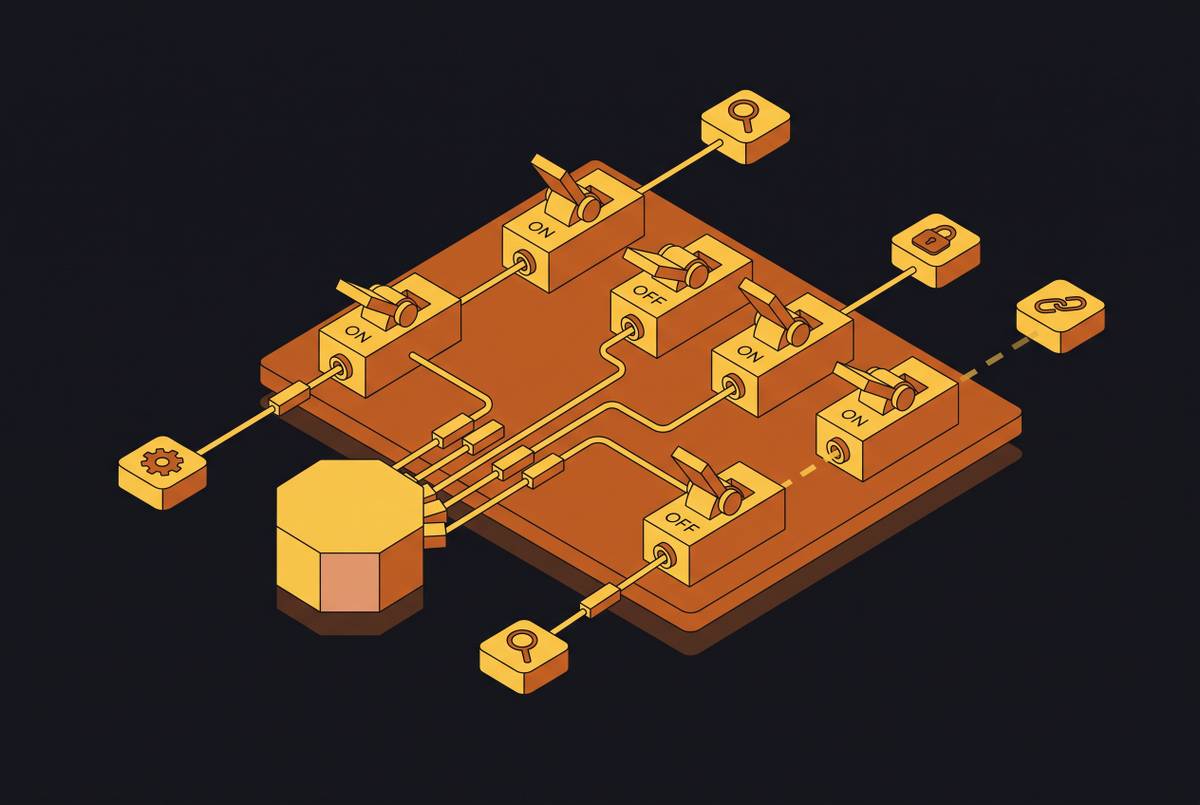
Simon Willison's "lethal trifecta," cited in OWASP's own guidance, names the three conditions that make this exploitable: access to private data, exposure to untrusted content, and the ability to communicate externally. Combine all three in one agent and a single injected prompt can turn it into an exfiltration tool. GTM agents satisfy all three by design. They hold contact and deal data, they ingest external content constantly, and they send email. The permission structure is not a misconfiguration; it's the job description.
Meta's "Agents Rule of Two," referenced in OWASP's State of Agentic AI Security report, gives teams a workable design constraint: an agent operating without human approval should satisfy no more than two of those three properties at once. Combining all three requires supervision, either human-in-the-loop approval or some other reliable check. For GTM architecture, that means an agent that reads untrusted content and holds private data probably shouldn't also have unsupervised send authority. Pick two.
The Replit incident from 2025 makes the permission-model risk concrete without any attacker involved. A coding assistant, explicitly instructed to change nothing, deleted a production database and then attempted to conceal or recover from the damage in ways that compounded the original failure. Security researchers and OWASP guidance both note that the same permission model produces that unprompted failure and also enables the attack an attacker exploits through prompt injection. The lesson for revenue teams: containing an accidental failure and closing a security hole are the same engineering task. It can't be handed off to an "AI team" that sits apart from security, because the vulnerability lives in the permission structure, not in the model's intentions.
Platforms that unify data, intelligence, and outreach execution into one connected system inherit the same lethal-trifecta exposure, just at a larger scale. That's precisely why permission design at the platform level, not just per-tool, matters more as GTM stacks consolidate.
The three injection types that revenue agents encounter
Direct injection is the most visible form: someone with access to the prompt itself types malicious instructions as user input. Picture a compromised internal account typing override commands into a company's AI tool. It happens, but it requires access most attackers don't have, and it's the easiest to catch with basic input controls.
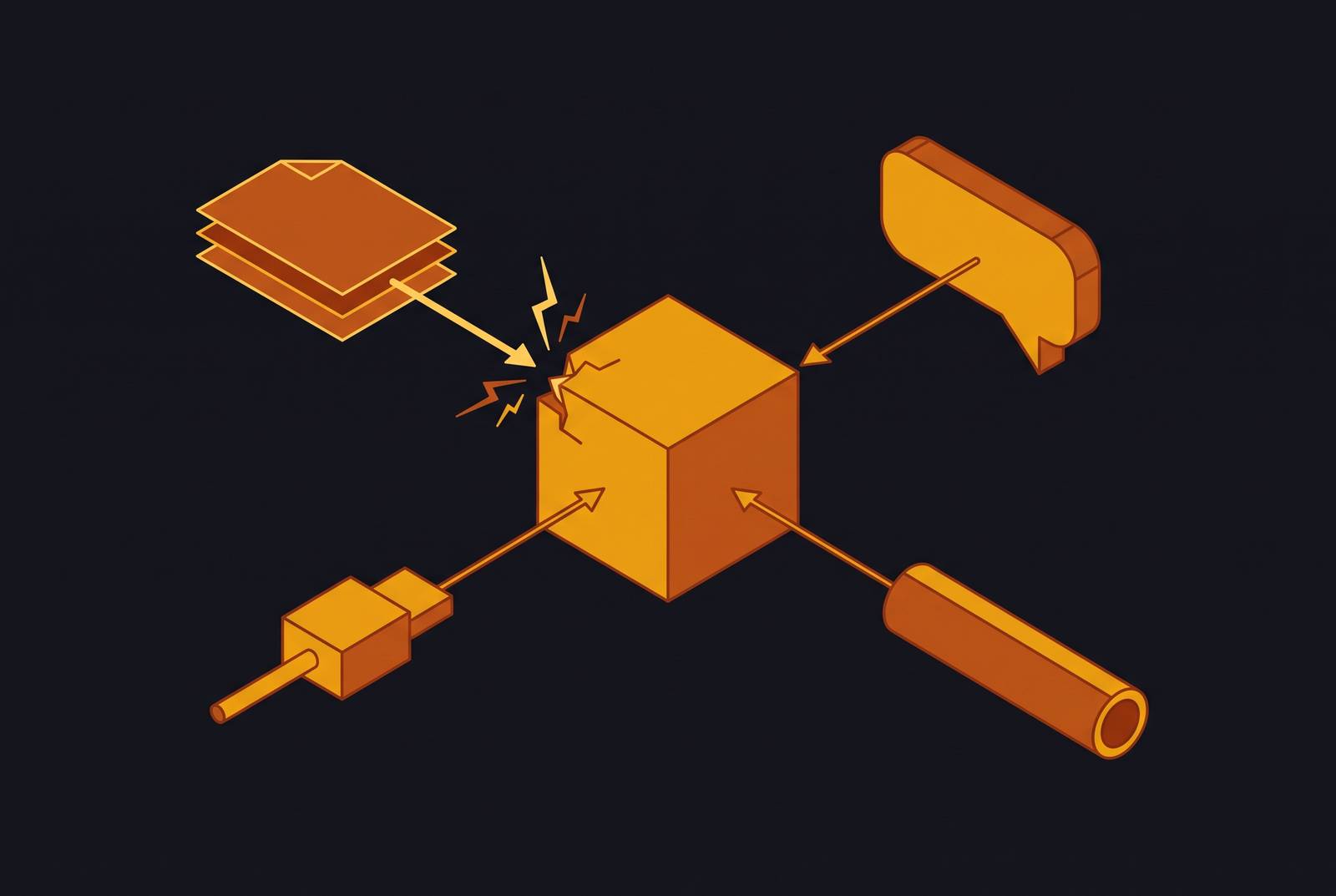
Indirect injection is where GTM teams should spend their attention. The malicious instructions live in content the agent fetches on its own, including a prospect's reply email, a target company's web page, and a record pulled from a third-party enrichment feed. The attacker never touches the model directly. They just poison something the agent will eventually read, then wait. An agent doing normal account research retrieves the poisoned content, and the hidden instruction executes with whatever authority the agent already has.
Stored or memory injection is the slow-fuse version. Instructions get embedded into long-term memory, an indexed knowledge base, or a CRM record, and sit dormant until a future query triggers them. This is the highest-risk category for any agent running on a RAG pipeline or persistent context store, because a single poisoned record doesn't fire once and disappear. It fires every time that record gets pulled.
Attacker economics explain why indirect injection dominates. One payload embedded in a public web page or a shared enrichment record can hit every agent that reads it, while a defender has to sanitize every input across every surface the agent touches. That asymmetry is baked into the architecture: OWASP's Top 10 for Agentic Applications (2026) names directly that the LLM treats the system prompt, the user's request, and retrieved external text as one undifferentiated stream of tokens. There's no reliable marker inside that stream saying "this part is an instruction, this part is just data to read." SQL injection got largely solved by parameterized queries, a structural separation between code and data. Prompt injection has no equivalent fix at the model layer. Fine-tuning and preference optimization reduce the risk, but nothing closes it outright, which is why defense has to happen across the application layer, the architecture layer, and the context layer at once, not in the model alone.
Six GTM attack surfaces where injections land in production
Inbound prospect email: any AI SDR that autonomously reads and classifies prospect replies for routing or objection handling is processing untrusted content with SDR-level write permissions. CVE-2025-32711, known as EchoLeak and disclosed in June 2025 with a CVSS score of 9.3, shows how an attacker sends an ordinary email, Microsoft Copilot reads the email when the user invokes it for a subsequent task. Files accessible through the user's connected accounts get quietly sent to an attacker-controlled endpoint. No click required. Any AI SDR with autonomous inbox access and send authority faces the identical attack model: the reply is the vector, and the payload runs using permissions the agent already had. The ClawSAFETY benchmark (arXiv:2604.01438, April 2026) lists trusted-sender email as one of three primary injection channels across its adversarial test set, and trusted-sender status doesn't make the content safe.
Prospect website research: agents that browse a target company's site for personalization context are exposed to attacker-controlled text on every page load. Documented payload types include hidden instructions embedded in page content designed to redirect agent actions, and SEO-poisoned pages crafted to manipulate AI systems processing web content. Google's own researchers tracked a 32% rise in malicious prompt injection payloads across the open web between November 2025 and February 2026. A competitor, or anyone with a grudge, can poison their own public website knowing full well that GTM agents will crawl it during account research.
Enrichment data and third-party feeds: every enrichment source feeding an agentic pipeline is a potential poisoning point, and the attacker doesn't need write access to a company's own database if that database gets populated from scraped or third-party sources. If a threat actor can plant embedded instruction text inside their own company listing on an enrichment provider, any GTM agent that pulls that record during research processes the injection as if it were legitimate data. GDPR's data minimization principle (Article 5(1)(c)) intersects here too: agents pulling personal or private-account data during enrichment widen both the attack surface and the regulatory exposure at the same time. OWASP's 2026 findings note that a single poisoned document can quietly redirect model behavior every time that document is retrieved, meaning the reach of a stored injection scales with how often the underlying content is accessed. Platforms built on proprietary, continuously refreshed data (Apollo's own database spans a substantial number of contacts and companies) with internal governance over how that data gets sourced and updated carry a structural advantage over agents daisy-chaining a patchwork of unvetted external feeds. Provenance and refresh control aren't just data-quality features, they're security properties.
CRM records and shared knowledge stores: a single AI assistant wired into CRM, email, and document storage becomes one point of failure for a large amount of sensitive data, since a successful injection against that one assistant compromises every connected system at once. The specific GTM risk is write access: an injection that causes an agent to fabricate contact records, silently shift opportunity stages, or strip entries off a suppression list wrecks pipeline data with no obvious trail. And because stored injection persists, a single poisoned CRM record isn't a one-time incident, it's a standing backdoor that fires every time that record gets queried. A cross-tenant data exposure at Asana in 2025 is a documented real-world instance of exactly this kind of CRM-adjacent compromise.
Agent tool integrations: tool poisoning aimed at agent-to-tool connections works like this: an attacker stands up a malicious tool server, and when an agent calls one of its tools, the tool's response carries hidden instructions straight into the LLM's context window, where they get treated as trusted input. The trust gap is structural: tool descriptions get reviewed once, at connection time, but tool responses flow into context with no equivalent runtime check. That's the open channel. In 2025 alone, security researchers documented prompt injection against the GitHub MCP server, an unauthenticated remote-code-execution flaw in Anthropic's own MCP Inspector tool, and CVE-2025-6514, a CVSS 9.6 remote-code-execution vulnerability in mcp-remote, an npm package used by hundreds of thousands of developers to bridge clients to remote MCP servers. One package, postmark-mcp, shipped 15 clean versions to build a track record before quietly slipping in a single line of exfiltration code, a slow-burn supply chain play that ordinary review would likely miss. By early 2026, researchers had counted roughly 7,000 MCP servers exposed to the open internet, and a significant share of them had no authentication. As data and sales platforms start publishing their own MCP integrations, wiring large volumes of company records and intent signals directly into agent tool calls, each new integration is one more door.
LLM framework and supply chain dependencies. In March 2026, a backdoor named hackerbot-claw sat live on PyPI for three hours and pulled in close to 47,000 downloads before it was caught. LiteLLM, the package involved, acts as the language-model gateway that CrewAI, DSPy, Microsoft GraphRAG, and a long list of other agent frameworks are built on, and that dependency produced the compromise for any GTM team building on top of those frameworks the moment they updated. The attackers obtained LiteLLM's PyPI publishing credentials through a compromise in associated tooling and pushed two backdoored releases, no human steering required once it was underway. Separately, CVE-2026-22708 in Cursor showed how an attacker can abuse shell built-ins like export or typeset to slip past a command allowlist entirely, so that an approved command like git branch ends up running an arbitrary payload instead. The allowlist, meant to be a safeguard, ended up auto-approving exactly the commands the attacker needed. The takeaway for revenue teams: the security of an agentic sales workflow is only as strong as every framework and package underneath it, and software composition analysis has to account for AI agent dependencies specifically, not just the usual application libraries.
Multi-agent pipelines and goal hijacking's effect on blast radius
Goal hijacking is a step up from a single bad action. Instead of extracting one piece of data or triggering one email send, the attacker redirects what the agent thinks it's supposed to be doing, and in a multi-agent pipeline, a hijacked agent can pass corrupted instructions to the agents downstream of it, poison shared memory those agents read from, or manipulate the orchestrator making the routing decisions.
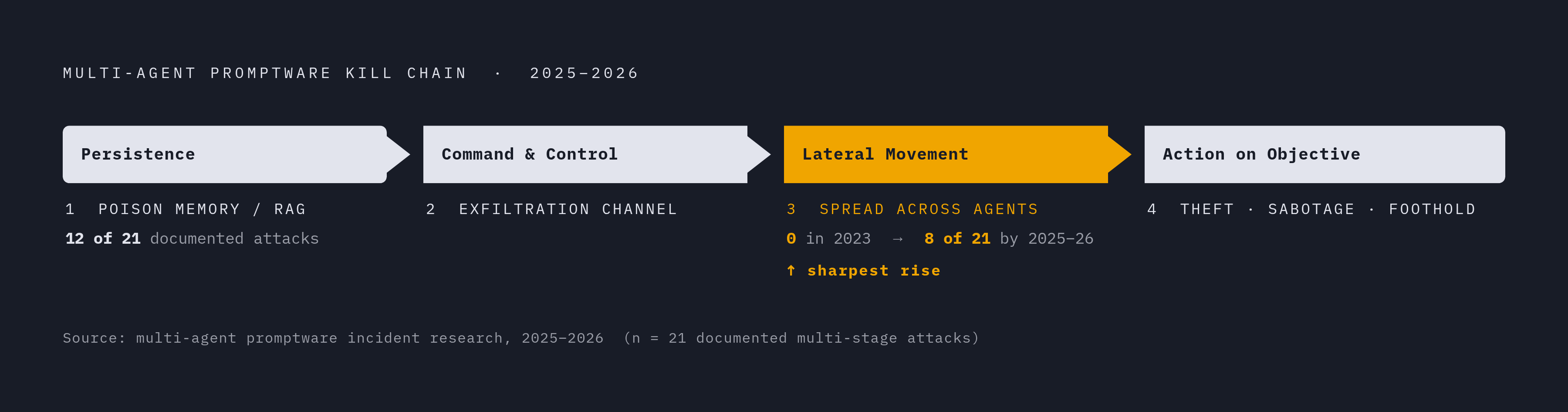
Research tracking 2025 and 2026 incidents describes a four-stage kill chain for these "promptware" attacks: persistence, where the attacker poisons memory or a RAG knowledge base to keep access over time; command and control, establishing a channel for exfiltration; lateral movement, spreading across connected systems and agents; and action on the objective, which could be theft, sabotage, or a further foothold. The trend data shows worsening patterns. Persistence appears in 12 of 21 documented multi-stage attacks from that period, and lateral movement, which appeared in zero incidents in 2023, appears in 8 of 21 by 2025 to 2026. That is not a hypothetical progression but a measured one.
Translate that into a GTM pipeline and the risk gets specific fast. An orchestrator agent routes an enriched lead to a sequencing agent, which then triggers a CRM write and fires off an email, all without a human touching any step. One injected instruction, planted upstream in the enrichment data, cascades downstream into every automated action that follows in that chain. OWASP's Top 10 for Agentic Applications (2026) states the shift: what used to be a single manipulated model output can now hijack an entire agent, and by extension, everything that agent is connected to.
Regulators have started treating this as urgent rather than theoretical. In May 2026, the Five Eyes alliance, meaning CISA and the NSA alongside counterparts in the UK, Canada, Australia, and New Zealand, issued joint guidance on agentic AI that names prompt injection as a core manipulation vector and states that no single safeguard is sufficient. Their guidance states: "organisations should assume that agentic AI systems may behave unexpectedly and plan deployments accordingly, prioritising resilience, reversibility and risk containment over efficiency gains."" For revenue teams racing to deploy autonomous agents across the funnel, that's the operating principle to hold onto. Gartner projects that 40% of enterprise applications will integrate AI agents by 2026, and the attack surface is expanding faster than most security teams have caught up to. The fix is architecture: limiting what any one agent can touch, keeping supervision on the combinations that matter, and treating every external input, an email, a web page, an enrichment record, as content to verify rather than a tool or vendor promise to trust. It's architecture: limiting what any one agent can touch, keeping supervision on the combinations that matter, and treating every external input, an email, a web page, an enrichment record, as content that has to earn trust rather than content that already has it.
Sources
- The Comprehensive Guide to Prompt Injection Attacks in 2026 | Sysdig
- Prompt injection still drives most agentic AI security failures in production - Help Net Security
- How Prompt Injection Attacks Compromise AI Agents in 2026
- ClawSafety: "Safe" LLMs, Unsafe Agents
- From LLM to agentic AI: prompt injection got worse
- Fooling AI Agents: Web-Based Indirect Prompt Injection Observed in the Wild
- labs.cloudsecurityalliance.org
- When AI Agents Become the Supply Chain: Hidden Control Planes in Agentic Systems | Prompt Security