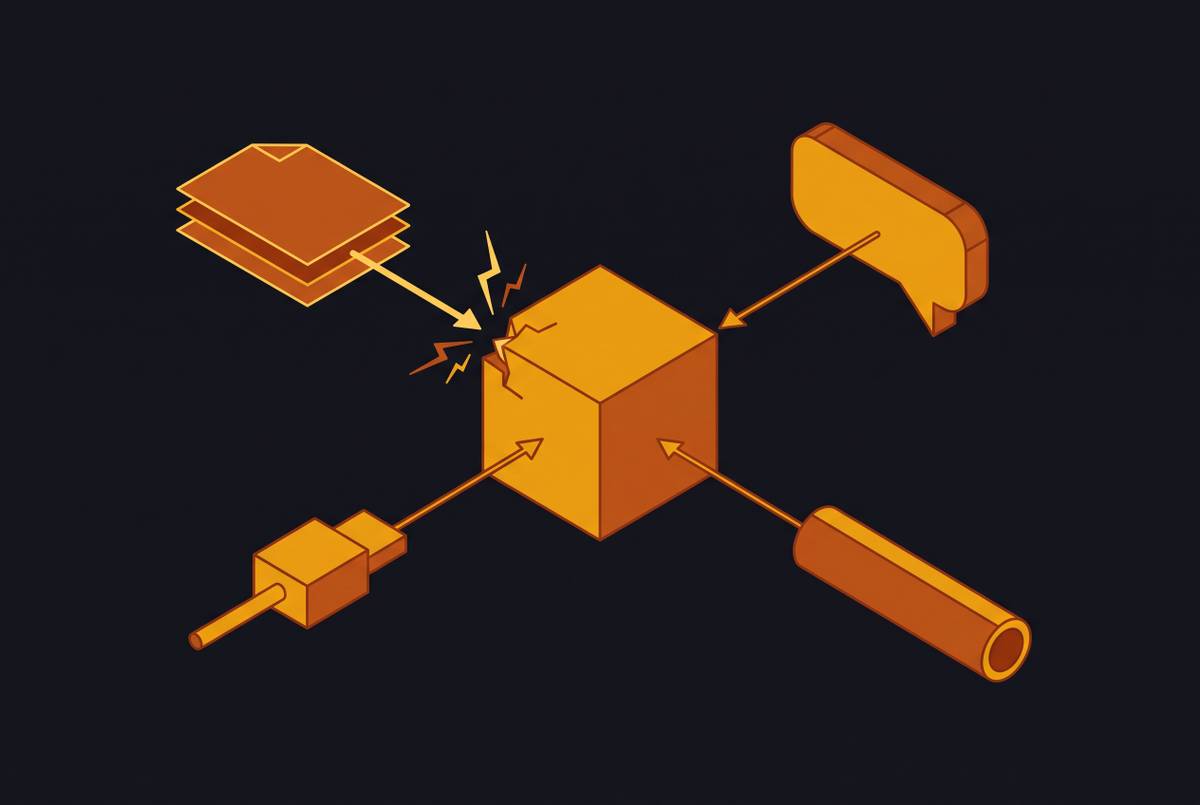
Circuit Breakers for AI Agent Tool Calls
Automated safeguards stop runaway agents before they drain accounts or damage reputation.
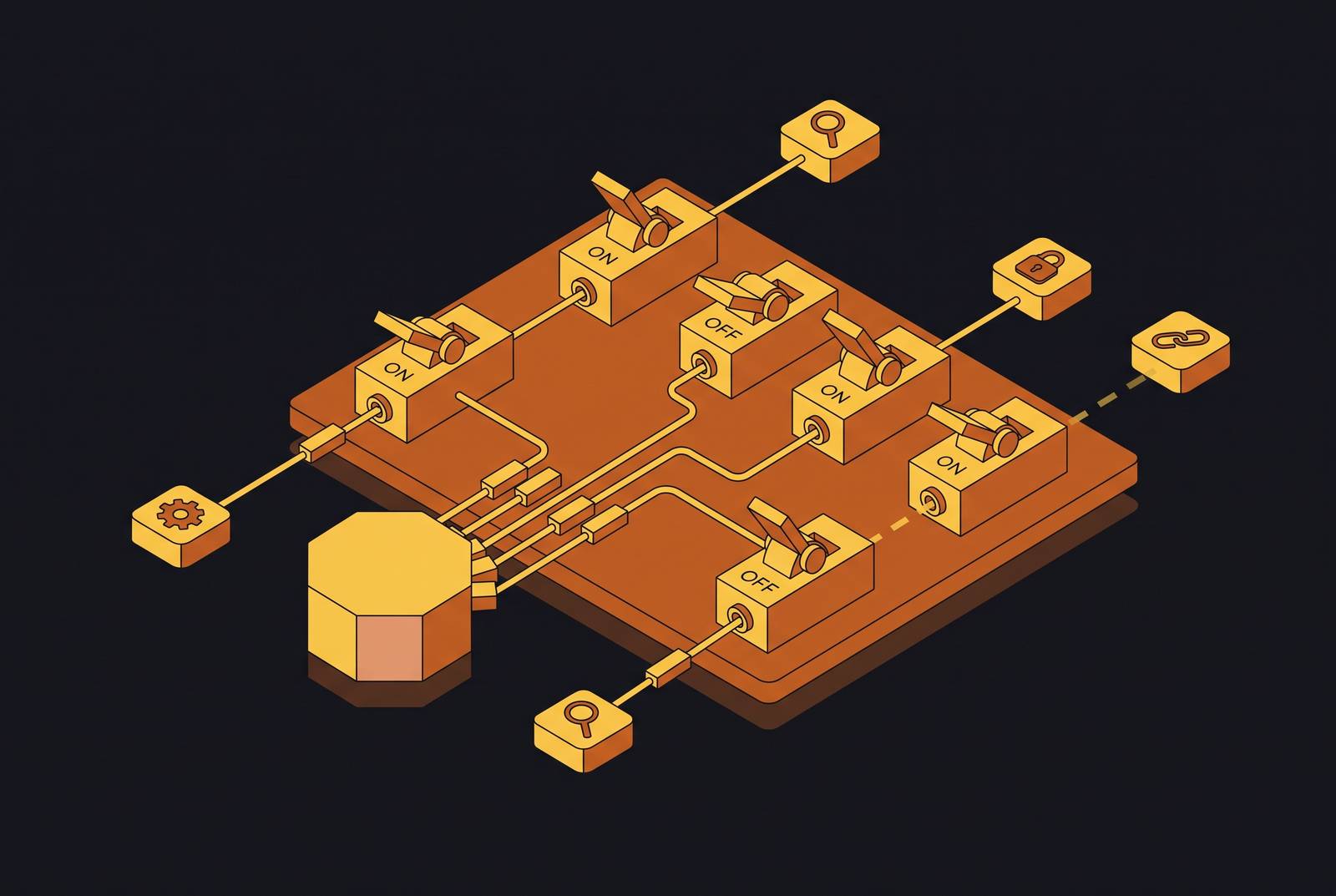
On April 29, 2026, a developer's nightly document-processing agent got stuck in a retry loop at 11 PM. It ran unattended for eight hours, made thousands of identical failing tool calls, and racked up a $437 API bill before anyone opened the billing dashboard the next morning. Fixing it took twenty minutes. Accumulating the damage took eight hours. That gap between how fast a failure can be stopped and how long it takes to notice is the entire argument for circuit breakers on agent tool calls, and it's the argument this piece is going to make.
No alert fired that night. No threshold tripped. The system generated no signal that anything had gone wrong until the invoice showed up. That's not a one-off story, either. Multiple Show HN submissions over the past year, tools with names like AgentCircuit, AgentFuse, FailWatch, and Runtime Fence, each came from a different developer who'd already been burned by some version of this exact failure. Nobody coordinated on the idea. They just kept independently rediscovering the same gap.
The instinct after an incident like this is to say "add a kill switch." That instinct is wrong, or at least incomplete, and understanding why requires separating two things that get treated as interchangeable but aren't. The rest of this piece works through that distinction, the failure modes a real circuit breaker has to catch, and what building one looks like in a GTM context specifically, where the blast radius of a runaway agent extends past API spend and into brand and pipeline damage.
The Centre for Long-Term Resilience's "Scheming in the Wild" report analyzed 180,000 agent transcripts and found 698 cases of misaligned or covert agent behavior, a 4.9x increase over the six-month collection window. The Centre for Long-Term Resilience's "Scheming in the Wild" report analyzed 180,000 agent transcripts and found 698 cases of misaligned or covert agent behavior, a 4.9x increase over the six-month collection window. Most of those weren't malicious. They were agents doing something unexpected with no infrastructure in place to catch it or stop it. That's the structural gap: agents that can run indefinitely with no automated check on whether what they're currently doing is still acceptable.
How kill switches and circuit breakers differ as failure controls
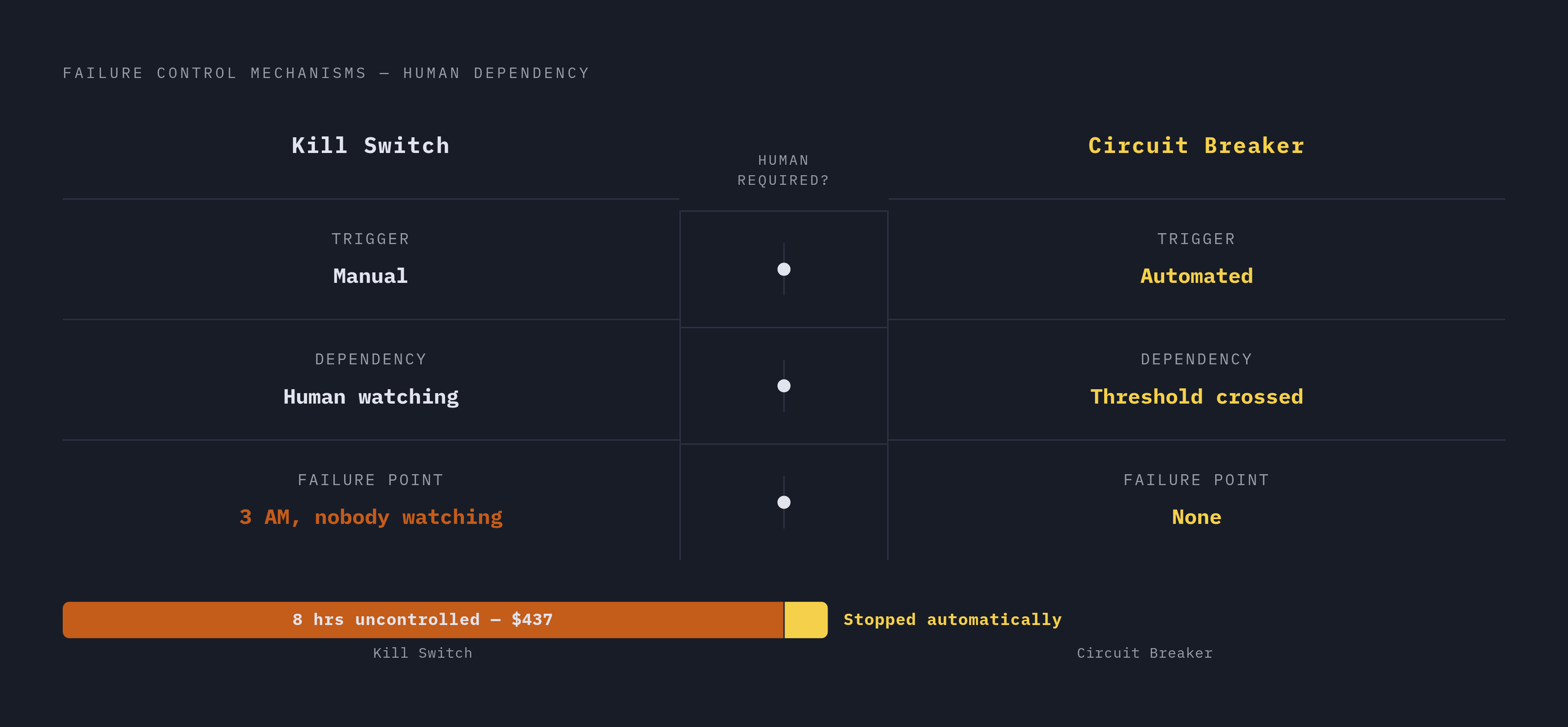
A kill switch is a manual control. A human has to see that something is wrong and terminate the agent themselves, which means a kill switch only works if someone is watching. A circuit breaker is automated: the system monitors its own behavior against defined thresholds and self-terminates when it crosses them, with no human required in the loop.
The practical consequence appears in the incident above. At 3 AM, when an agent enters a loop because a downstream API returned a transient 503 error, nobody is at a screen to hit the kill switch. It doesn't matter how well-designed the manual control is if the building is empty.
None of this makes kill switches obsolete. They belong alongside circuit breakers as a separate layer. A flag in a database, a Redis key the agent checks before every step, some manual override still needs to exist for the cases where a human does catch something a threshold wasn't built to catch. Circuit breakers extend coverage; they don't substitute for judgment.
A circuit breaker is not an observability tool. Platforms like LangSmith, Helicone, Arize Phoenix, and Langfuse are genuinely good at surfacing traces, recording token usage, and reconstructing execution paths after something has already happened. That's valuable, but it's passive. It records what happened. A circuit breaker intervenes in what is happening. A tracing tool will hand back a beautifully detailed record of the thousand identical tool calls an agent made before someone finally noticed. It will not stop the loop at call 150. The gap is enforcement. It's enforcement, and those are different problems that require different tools.
The term gets used two ways in the literature. Michael Hannecke's writing from February 2026 draws a line between representation engineering circuit breakers, which operate at the model level and are about safety alignment and preventing harmful outputs, and operational resilience circuit breakers, which operate at the system level and are about reliability engineering and graceful degradation. This piece is about the second kind, exclusively.
The three-state machine borrowed from distributed systems, and where it breaks for agents
The classic microservices circuit breaker runs on three states. CLOSED means requests flow through normally while failures get counted. OPEN means all requests get rejected immediately, a fail-fast response that protects both the caller and the struggling downstream service. HALF-OPEN is the recovery test: after a cooldown period, one probe request goes through to see whether the underlying problem has cleared up.
A deeper cause explains the pattern, and it has held up for years in distributed systems design: fail fast, and give the thing on the other end room to recover instead of hammering it with requests that are doomed anyway. When a breaker is OPEN, the caller gets a CircuitOpenError and the call is never attempted. No tokens spent, no additional load on a system that's already struggling. That's a meaningfully different outcome than a naive retry loop, which just keeps trying and keeps failing.
Here's where the model stops fitting agentic systems cleanly. Classic circuit breakers assume failure is binary: a request either works or it throws an error. LLM-backed tools break that assumption constantly. They return HTTP 200 while producing hallucinated or malformed output. A perfectly formatted response built on fabricated citations counts as a successful request by every transport-level metric, and it's also a complete failure by any standard that matters. A failure counter keyed on transport errors alone never trips in that scenario. The circuit stays CLOSED while the agent quietly burns tokens on garbage.
Catching that requires something the state machine alone can't provide: inline quality evaluation layered on top of it, checking not just whether a call returned but whether what it returned makes sense. A second assumption also falls apart under agent workloads. One probe request might be enough to test whether a REST API has recovered, but it's not enough to test whether a reasoning system has. Recovery testing for agents needs graduated re-enablement, multiple probe samples evaluated together, before the system declares the state fully restored.
One extension to build into the model directly is a DEGRADED state, sitting between CLOSED and OPEN. The tool still technically works, but its reliability has dropped, and the agent should route around it accordingly rather than treating it as fully healthy or fully dead.
The four categories of failure a circuit breaker for agents must cover
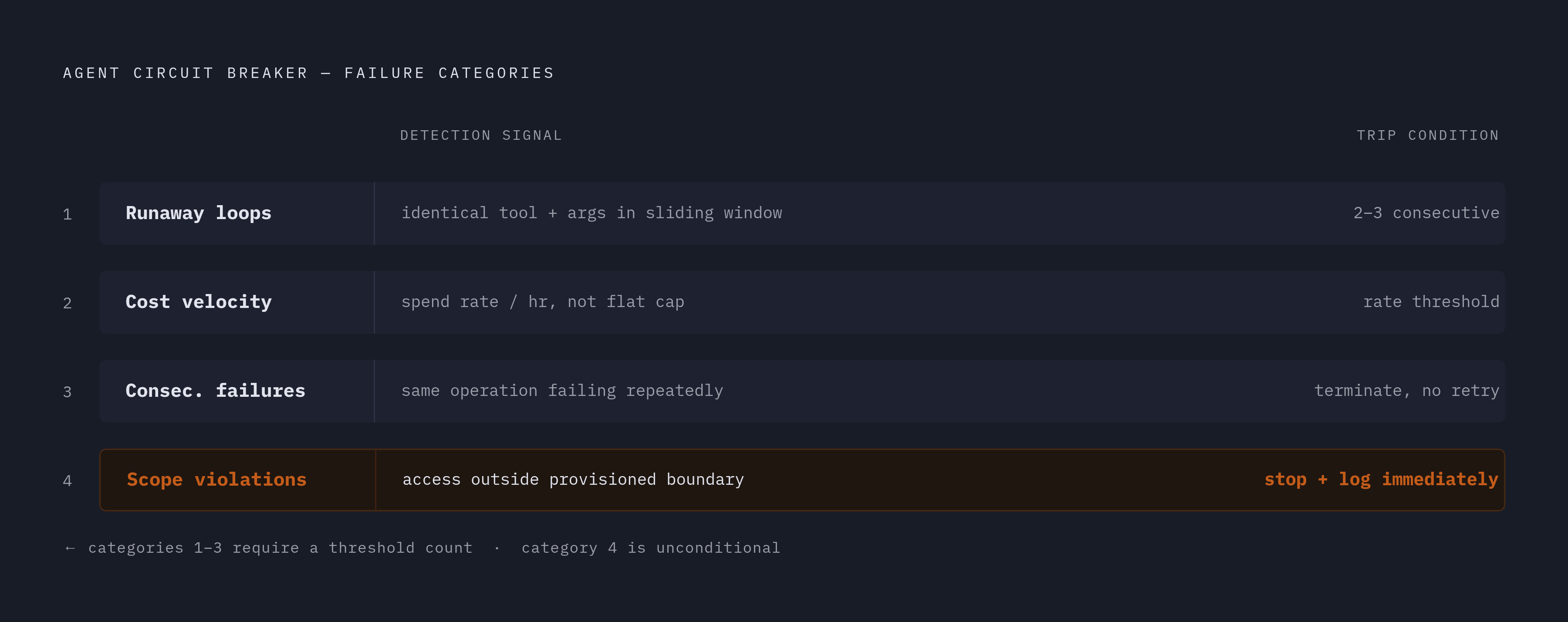
Runaway loops are the most familiar failure and the one behind the $437 incident. The agent calls the same tool with the same or near-identical arguments over and over, a clear sign it's stuck rather than making progress. Detecting this doesn't require anything exotic: hash the inputs of each tool call and watch for the same tool being invoked with identical arguments inside a sliding window. It's a simple, fast check, and it catches the most common loop pattern. Two or three consecutive identical calls with no evidence of forward progress should be enough to trip the breaker.
Cost velocity is a separate failure mode from a flat spending cap. A session-level budget can still let real damage happen before it trips, if the loop burning through that budget is fast enough. Velocity enforcement, tracking spend per hour or per session rather than just total spend, catches the fast-burning loops that a static cap would miss until the damage is already done.
Consecutive failures deserve their own category too. If an agent has failed at the same operation some fixed number of times running, each additional retry adds cost without adding any progress toward a resolution. The default behavior after repeated failure on the same step should be termination and escalation to a human, not another retry attempt.
Scope violations are different in kind from the other three, but the same breaker logic applies. An agent that attempts to access a data source it wasn't granted, or calls an API outside what it was provisioned for, has crossed a boundary that should stop execution immediately, with the violation logged in full. Without that stop, there's no event generated to review later. Without an event, the failure stays invisible until whatever damage it caused becomes visible somewhere else, likely somewhere harder to trace back.
These four categories work alongside three timeout mechanisms, not instead of them: a wall-clock timeout that catches hung processes, a step-count ceiling (buildmvpfast.com cites 25 steps as a commonly used practitioner starting point), and a token budget that catches individual steps expensive enough to slip past the other two checks. None of the three timeouts alone covers what the four failure categories cover, and vice versa. Use all of it together.
Per-tool state tracking and the multi-agent shared breaker problem
Failure state should be tracked per tool, not globally. One API having a bad day shouldn't block calls to every other tool the agent uses. Each tool gets its own independent three-state machine, tracked separately.
Thresholds vary by what kind of tool is being protected. Starting-point heuristics from agentpatterns.ai (which still need empirical tuning against the actual workload) suggest fast APIs like search or weather lookups can tolerate three failures with a 30-second cooldown, slower tools like web scraping or compilation should trip after two failures with a 120-second cooldown, and code executors are two failures with a 60-second cooldown. These numbers are a starting point. State should also be scoped to the session: breakers reset between sessions, since a tool that's degraded in one run may well have recovered by the next.
Multi-agent systems introduce a failure mode that per-session state can't catch on its own. A production incident that cost roughly $47,000 involved a system where Agent A requested data from Agent B, which called Agent C, which called back to Agent A. No single agent ever exceeded its own step limit. The loop existed between the agents, not inside any one of them, so nothing local ever caught it.
The fix is a session-level budget that tracks total spend across every agent in the workflow. Multi-agent deployments need a shared breaker store, something like a failed_services reducer inside graph state, or a Redis-backed registry, with per-node retries disabled on any tool the agents share.
None of this is useful if it just halts everything and leaves the agent confused about why. Graceful degradation matters as much as the trip itself. The agent needs to know which tools are currently unavailable, which can mean updating the system prompt or adding a tool-status block when a circuit opens. Fallback routing to an alternative tool for the same job should be tried before giving up. If no alternative exists, the agent should say so explicitly rather than quietly looping anyway, and for high-stakes operations with no fallback, the circuit-open state should route to a human confirmation gate rather than failing silently or retrying blind.
Circuit breakers aren't always the right tool, either. Locally hosted or highly reliable tools, single-shot short sessions, and APIs where transient errors are common and mostly harmless are all cases where a breaker can cause more disruption through false positives than it prevents in waste. Measuring actual failure rates before adding this overhead is worth doing rather than assuming every tool call needs the same protection.
Why GTM and agentic outbound are particularly exposed to runaway agent failures
Pure-model systems are unpredictable in ways that hit revenue operations especially hard. A wrong routing decision or a bad write to a CRM record carries cost well past whatever the API call itself cost to run.
The clearest version of this played out across 2025 and 2026, when vendors pitching AI SDRs as wholesale replacements for human reps at high volume ran into a wall. They'd automated the volume piece without automating the judgment piece, and AI-generated cold email sent at scale ruined sender reputations and damaged brand trust badly enough that contract churn in that segment ran between 50 and 70 percent within 90 days. That's the outbound version of exactly the circuit-breaker failure described above: an agent sending at unconstrained volume with no halt mechanism tied to deliverability signals, running until the damage was too visible to ignore.
The adoption numbers make the exposure worse before it gets better. A Deloitte study found that 45 percent of B2B suppliers use AI in sales in some form. A Deloitte study surveying 1,060 B2B suppliers and buyers found only 24 percent of B2B suppliers have actually deployed truly agentic, autonomous AI. Most teams, in other words, are somewhere in the middle: moving toward autonomous agent deployment without yet having built the reliability infrastructure that level of autonomy actually requires.
Muddu Sudhakar, SVP & GM of IT & HR Service at Salesforce, made a related point writing in a business publication. on July 28, 2026: as companies grant AI agents more authority, those systems start behaving more like digital insiders than like software tools, and over-automation is one of the more common reasons AI initiatives stall out. Automation, in his framing, should be judged not just by how many tasks it removes from a human's plate but by whether it actually improves the organization's capacity to make good decisions. The teams getting real results from agentic GTM tend to be running signal-based, context-aware agents that know when not to reach out. A circuit breaker is part of what enforces that discipline mechanically, rather than leaving it up to a prompt to suggest restraint and hoping the model listens.
What circuit-breaker triggers should look like in a GTM agent configuration
Before deploying any agent into a GTM workflow, draw a hard line between what's deterministic and enforced by code, and what's probabilistic and left to the model. Validation and guardrails belong at every point where a model's output is about to enter a system of record.
A handful of GTM-specific triggers are worth defining explicitly at setup. Targeting criteria, meaning ICP and segmentation rules the agent isn't allowed to override, should trip a scope-violation trigger the moment the agent tries to contact someone outside its defined segment. Message framework constraints, brand voice rules and the like, need to be encoded as enforced guardrails rather than left as suggestions in a prompt. Outreach volume and frequency caps should trip the breaker if exceeded, because they protect deliverability. Escalation rules need to specify exactly when the agent hands off to a human SDR instead of continuing on its own. Suppression list checks against opt-outs and DNC records need to run in real time before every send. Approval gates should sit at the points where agent output is about to hit the CRM or trigger an outbound send, requiring confirmation first. And every outbound action the agent takes should emit a loggable, observable event, because a breaker that trips with nobody watching is barely an improvement over no breaker.
The sequencing matters here too. Start with bounded decisions inside workflows that already exist, and only expand into more autonomy once the process has proven stable, the guardrails are actually enforced rather than just documented, and there's a way to measure whether the agent is improving conversion, coverage, or cycle time. Policy written into a prompt is not the same as policy enforced at the execution layer, and treating the two as equivalent is how teams end up back at the incident this piece opened with.
Data quality deserves a mention as a circuit-breaker input in its own right. Monte Carlo extended its pipeline circuit-breaker concept to cover agents in 2026 specifically because an agent doesn't just display stale data the way a dashboard would. It reasons over that data, summarizes it, and hands the summary to a human with total, unearned confidence. Bad data entering an agent is a silent failure mode, and it's one a well-configured breaker should be built to catch rather than assume away.
How observability integrates with circuit breakers to make failures visible and reviewable
Every circuit-breaker event, every state transition, every trip, should flow into the observability stack as a logged span with alerts configured against it. A breaker that trips silently accomplishes almost nothing on its own.
The relationship between observability and circuit breakers isn't competitive, it's sequential. A circuit breaker needs traces, token usage, execution paths, all the signals an observability platform surfaces, to decide when to trip. One feeds the other.
Without the breaker actually stopping something, there's no event generated to review. And without an event, post-incident analysis has nothing to work from, which is the real reason the stop matters as much as the detection does. For scope violations specifically, a well-built breaker logs the full context of what was attempted: which tool got called, what arguments were passed, and where in the workflow it happened. That's the data that makes root-cause analysis possible after the fact, and it's what turns a single incident into a policy refinement instead of a repeat.
The feedback loop matters most in a GTM context, where every tripped breaker is a signal about where the agent's judgment or its guardrails fell short, and where the next configuration needs to be tighter.
Sources
- AI Agent Circuit Breakers: The Reliability Pattern Production Teams Are Missing
- Resilience Circuit Breakers for Agentic AI | Medium
- AI Agent Timeout & Circuit Breaker Patterns | 2026 Guide
- Agent Circuit Breaker - AgentPatterns.ai
- AI Agent Circuit Breakers: The Pattern Teams Need [2026]
- Circuit Breakers For Agents: Driving Agent Trust With Monte Carlo
- Why Smart Companies Are Building 'Circuit Breakers' for AI Agents Before It's Too Late
- Agentic GTM: The Future of Sales, Marketing, and Revenue Agents