Runbooks for Common OpenClaw Production Incidents
Fast detection and recovery paths for OpenClaw's most destructive production failure modes.
OpenClaw is a self-hosted AI agent gateway, and that single fact determines almost everything about how incidents on it must be handled. It sits across messaging channels, sandboxed tool execution, ClawHub skills, memory, and model inference as the core security boundary for the whole deployment, and because it runs on infrastructure the operator controls, the operator owns every incident that happens on it. There is no vendor on the other end of a support ticket absorbing the blast radius.
The architecture is built from a small number of components: the Gateway, Clients, Nodes, Sessions, Tools and Skills, and Memory. All of them connect through a single long-running process, and that process is both the thing that makes OpenClaw useful and the thing an operator has to secure and recover when it breaks. With a managed agent platform, the vendor's infrastructure and incident response team spread that risk instead. OpenClaw inherits the full trust of whatever machine it runs on, along with every credential stored there, so if you install a ClawHub skill into that environment, you're running third-party code with persistent access to those same credentials.
Development on the project moves at a pace that outstrips most teams' ability to document it. Hundreds of pull requests and issues get updated daily, and minor releases ship on a rapid cadence, so the production surface shifts constantly and failure modes accumulate faster than operators can track them through changelog reading alone. Production deployments of OpenClaw share a predictable set of failure modes, and each one has a concrete recovery path. The rest of this piece lays out four of them as runbooks, organized by what triggers the failure, how to catch it, and what to do when it happens.
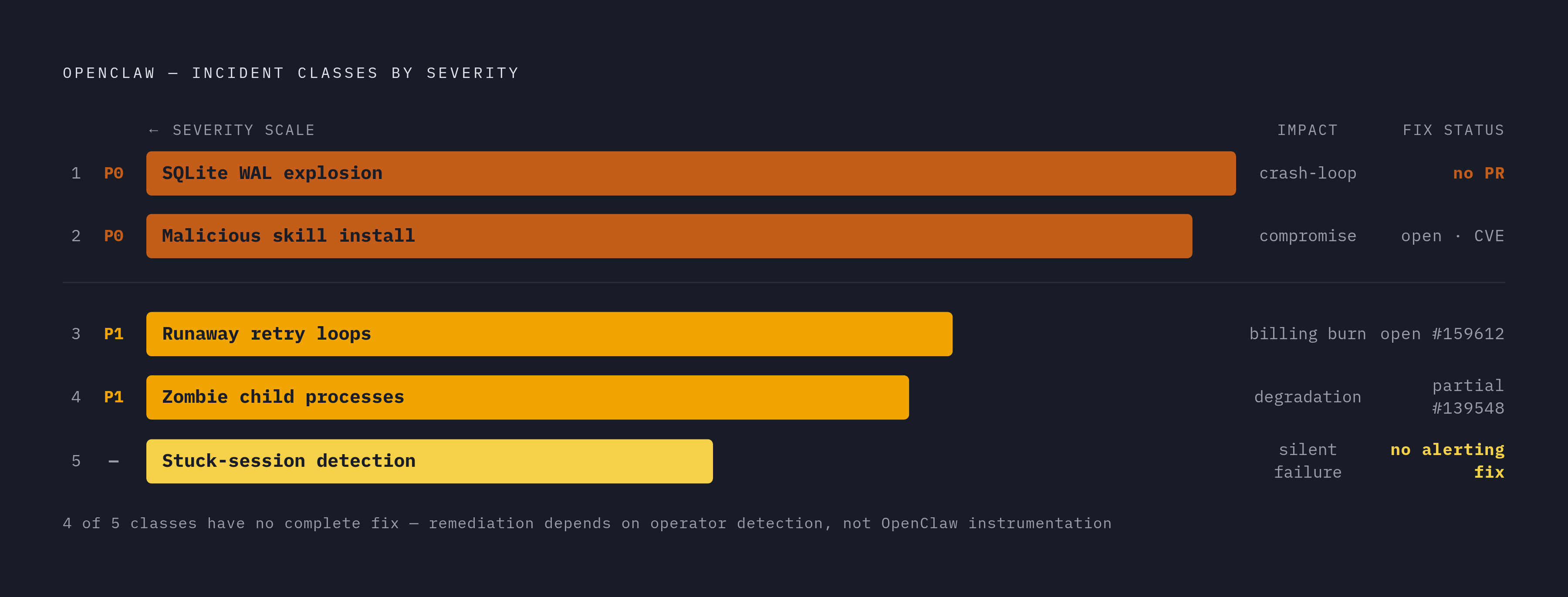
How the Five Incident Classes Map to Severity
Context engine load diagnostics in OpenClaw do not currently exist, a gap tracked under Issue #129019 (unverified), and configuration and plugin failures often fail silently as a result. Every runbook here compensates for that gap by routing detection through monitoring external to OpenClaw itself: process tables, API provider billing dashboards, cloud billing alerts, and scheduled file-size checks. None of the detection strategies below assume OpenClaw's internal alerting will fire, because it often does not.
Five incident classes recur across production OpenClaw deployments. SQLite WAL explosion is a P0 crash-loop, and it takes the Gateway down. Runaway retry loops produce a P1 billing blowout, and the Gateway keeps running while it burns API spend. Zombie child process accumulation is a P1 degradation pattern with no fix PR currently closing it. Malicious skill installation is a deliberate supply-chain compromise, not a bug. A fifth class, stuck-session detection failing to fire inside the diagnostic layer, threads through several of the runbooks below. What unites all of them structurally is that each one depends on an operator-side detection layer sitting outside OpenClaw, because the system's own instrumentation often fails to surface the problem before it becomes expensive or destructive.
Runbook 1: SQLite WAL explosion (P0 - crash-loop)
OpenClaw persists session history to an embedded database, and when agent turns run concurrently, the write-ahead log (WAL) file can grow without bound, because it doesn't checkpoint down to a stable size. Left unaddressed, the WAL file grows large enough to block Gateway startup entirely, which turns a performance problem into a full outage.
Detection for this runbook rests on one metric, tracked on a schedule rather than waited on:
- Monitor WAL file size as a scheduled check, not an ad hoc one.
- Set an alert threshold well below the size at which startup itself begins failing, so there's lead time to act before a crash-loop begins.
- Treat a threshold breach as a P0 regardless of whether the Gateway is still responding normally at the time.
Immediate mitigation requires stopping the Gateway, manually checkpointing and truncating the WAL file, and restarting. That buys time but doesn't address the underlying contention. Until the contention bug is resolved, concurrent agent turns should be limited to fewer than three; this reduces the write pressure that causes the file to balloon.
Patch status here needs care, because the obvious upgrade path does not fully close the problem. Version 2026.9.8 is a patch release that addresses messaging, memory, and update and startup issues, and anyone running 2026.9.5 through 2026.9.7 should update to it immediately to avoid out-of-memory crashes, data loss, or startup failures tied to those versions. That update does not resolve WAL file bloat itself: Issue #143524 remains open with no fix PR linked as of the release. A related issue, Issue #114612, covering memory-core retention, also has no fix PR linked as of the October 2026 digests. For deployments that need maximum stability over new features, v2026.8.35 is the current extended-stable, gateway-only release; it carries critical security updates, reliability fixes, performance improvements, and new model support without introducing breaking changes, making it a reasonable anchor point for operators who want to avoid chasing every minor release.
Recurrence watch after any intervention means keeping the WAL size metric in place permanently, not just during the incident. After applying the v2026.9.8 patch, confirm checkpointing is actually running by watching WAL size over two days of normal load rather than assuming the patch note is sufficient evidence on its own.
Runbook 2: Runaway retry loops and billing blowout (P1)
OpenClaw ships with no API rate limiting, no token budgets, and no circuit breakers by default. The diagnostic layer's stuck-session detection does not reliably fire to interrupt that loop, so external billing controls carry the real weight in this runbook.
Detection depends on tripwires set up before any incident occurs:
- Set a spending alert at the API provider (Anthropic, OpenAI) at a fixed percentage above expected monthly usage, and treat any trip of that alert as a P1 until the cause is confirmed.
- Watch the API provider's usage dashboard for rapid-fire calls with short inter-call intervals; normal agent turns don't produce continuous call patterns like that.
- Use a GCP billing anomaly alert or an equivalent cloud billing alert as a second external tripwire, since it catches what OpenClaw's own diagnostics miss.
- Check whether the Gateway version predates the v2026.9.8 fix for Issue #159612, the tracked bug covering infinite retry loops in subagent completion settlement.
Immediate mitigation starts with killing the stuck session or restarting the Gateway, but a restart alone doesn't prevent recurrence if the underlying condition that caused the loop is still present. If a session can't be terminated in-process, revoking the upstream API key is the fastest hard stop available, followed immediately by rotating the key. Not every downstream error should be treated as transient: permanent-error loops, such as repeated Telegram delivery failures returning a 400, need a circuit-breaker configuration rather than a single global retry rule that keeps hammering a channel that will never succeed.
Permanent remediation requires some skepticism about the patch record. Issue #159612 remains open as of v2026.9.8 with no confirmed fix release, so operators shouldn't assume this release resolves it. At minimum, you need a circuit-breaker at the operator level, with a defined failure threshold and reset timeout, configured independently of whatever OpenClaw ships natively. An API provider spending limit set at a fixed multiple of expected monthly usage acts as a backstop that holds even if in-process controls fail. A feature request exists to add per-turn send budgets for the message tool, so you should track its status as a future hardening option, but it isn't available yet.
Recurrence watch means verifying, after any patch, that subagent completion settlement no longer produces continuous retries under a test workload before production traffic gets restored in full. Keep the external billing alert in place permanently regardless of patch status, because it remains the earliest layer of detection for this entire incident class.
Runbook 3: Zombie child process accumulation (P1 - no fix PR)
Hook and tool child processes, including openclaw-hooks, bash, and codex, are not reliably reaped after they finish executing. This failure mode doesn't crash the Gateway, unlike the WAL explosion. It accumulates, and the accumulation produces progressive runtime degradation across all runtimes the Gateway touches. The tracking issue, Issue #97616, is rated P1, and as of October 2026 there is no complete fix PR closing zombie child process accumulation. A partial fix, PR #139548, has been merged, but it addresses only one Linux-specific path.
You detect it by watching the process table directly rather than waiting for a symptom to surface elsewhere:
- Monitor the process table for unreaped children of the Gateway process.
- Look specifically for openclaw-hooks, bash, and codex entries sitting in zombie state, marked Z in process status.
- Correlate rising zombie counts with Gateway performance degradation such as increased latency, missed turns, or event loop stalls, since these are the downstream symptoms operators are more likely to notice first.
Immediate mitigation is a Gateway restart, which clears accumulated zombies. That's a pragmatic interim control rather than a fix, and it should be treated as such in any incident log. With no fix PR linked for the underlying issue as of October 2026, scheduled restarts remain a reasonable part of an operational runbook until the issue shows a confirmed resolution. Running openclaw doctor after each restart catches configuration or state inconsistencies that may have been introduced during the degraded period before the restart.
For recurrence watch, if a zombie process count exceeds a set threshold, treat that as a signal to schedule an earlier restart rather than waiting for performance to visibly degrade first. Issue #97616 and Issue #160548 should be tracked together, since both represent process lifecycle failures that currently lack durable fixes, and a resolution to one may inform expectations about the other. Left unmanaged over longer stretches of autonomous operation, this kind of slow degradation is also the condition under which other failures, including security incidents, become harder to catch in time. The next runbook picks up from there.
Runbook 4: Malicious skill installation and supply-chain compromise
ClawHub skills are executable third-party code, and when installed they run with the full trust of the host machine and every credential stored on it. This incident class differs from the first three in kind rather than degree: it is not a bug in OpenClaw's runtime but a weaponized feature of its ecosystem. The ClawHavoc campaign showed that coordinated, malicious skill publishing can operate at scale before human researchers catch it, and CVE-2026-25253, with a CVSS score of 8.8, demonstrated that a single malicious link click can achieve remote code execution.
Prevention has to start before any skill is installed. You should treat every ClawHub skill as untrusted code execution, no matter the star count, README quality, or how legitimate the publisher looks, because the ClawHavoc campaign used professional documentation and credible-sounding skill names to deceive users and evade automated screening. ClawHub has integrated VirusTotal and ClawScan for proactive screening of published skills, and on June 1, 2026, OpenClaw announced a skill-screening partnership with NVIDIA for the platform. Those controls reduce risk; they do not eliminate it, and marketplace screening should never be treated as the sole gate protecting a deployment. Containerized Gateway deployments carry an additional gap documented under Issue #125284, rated P0 for security: ask-mode approval prompts do not block execution in these deployments, so commands run before approval is actually granted. So any containerized deployment posture needs to account for that gap directly, rather than assume the approval step protects the way its name implies.
Detection after a skill has already been installed follows three checks. Running openclaw secrets audit identifies what credentials are exposed in paths like ~/.openclaw/credentials/ immediately after any suspected malicious skill installation. Skill setup instructions deserve a close read of their "Prerequisites" sections for anything that directs a user to download a helper tool or run a terminal command, since that is the exact social-engineering vector the ClawHavoc campaign used to get past both users and automated screening. Connected OAuth tokens and API integrations should be audited for unexpected grants or new entries that postdate the skill installation, since a compromised skill's first move is often to expand its own access quietly.
If operators confirm a malicious skill installation, they should treat the incident as a credential compromise, not merely a software removal. Revoking exposed credentials, rotating API keys, and auditing OAuth grants need to happen as a unit, because the skill ran with the full trust of the host machine for whatever period it was active, and any access it touched should be considered compromised until proven otherwise.